

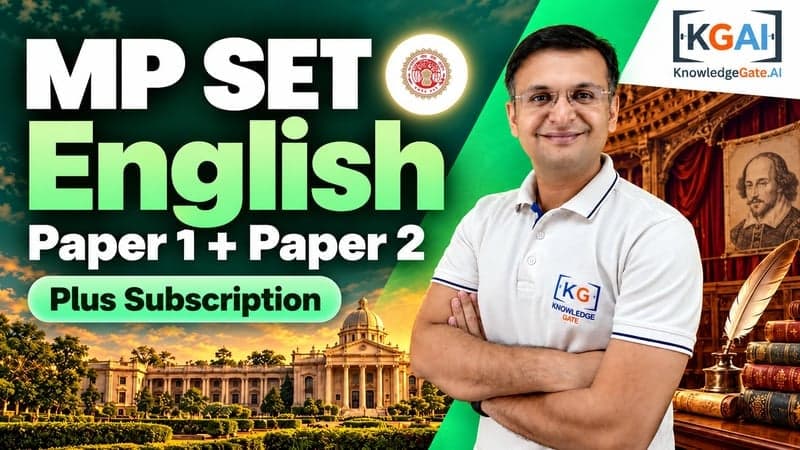
MP SET English (Paper 1 + Paper 2)
(Complete Course)
Need help choosing this course?
Our counsellor will help with pricing, syllabus, and enrollment.
About MP SET English (Paper 1 + Paper 2)
MP SET English with Paper 1 and Paper 2 in one course: all 20 units, MP SET and UGC NET PYQs, practice questions and solutions.
Compare MP SET English (Paper 1 + Paper 2) with all courses💡 Our approach Every aspirant has limited resources, yet gives an honest, full effort: full energy, full time. But most of that time goes into watching videos, and it feels like the preparation is going well. Which topics the questions come from, how they are framed, how difficult they are and which topics truly matter, becomes clear only when you solve a large number of previous year questions . This is where most students miss out, and they cannot perform in the exam at the level of their real potential and calibre. At KnowledgeGate, we solve exactly this problem: you solve plenty of PYQs and practice questions at every level (course, subject, topic, subtopic), so you understand the exam completely and your hard work turns into success. 🤖 How the platform helps you Goal Slider: set your target for your category (General/OBC/EWS/SC/ST), customise the course and see how much content is enough to reach that target. Syllabus Hotspots: real PYQ data shows which subjects, topics and subtopics get the most questions. Problem Solving: plenty of questions on every subject, topic and subtopic, each with a solution. Leaderboard: see your rank, and what the top aspirants are doing. Progress Monitor: see subject by subject where your work is complete and where more is needed. Community: a social space for aspirants: ideas, questions, polls, videos and comments. One-to-one chat: talk directly with other aspirants and form study groups. Battles: game-style practice: compete with other aspirants on questions. Course Captain: your mentor and single point of contact for the course, the platform, any confusion or feedback. 📚 What's inside The full course, organised into 20 units, 280 topics and 1424 subtopics . 17,000+ questions (PYQ + practice), each with a solution. Notes: notes for every topic, for concepts and revision.
Select Your Plan
Compare plansPlus includes
- Notes & PDFs · Download
- PYQs · Unlimited
- Practice Questions · Unlimited
- Video Solutions · 5 / day
- Test Series · All tests as per academic calendar
- Progress Monitor
What you get
- Validity
- Until 31 Dec 2027
Course Curriculum
Paper - 1 | Unit - 1 | Teaching Aptitude
- Concept and Objectives of Teaching / शिक्षण की अवधारणा एवं उद्देश्य
- Levels of Teaching / शिक्षण के स्तर
- Learner's Characteristics / शिक्षार्थी की विशेषताएँ
- Learning: Nature and Theories / अधिगम: प्रकृति एवं सिद्धांत
- Cognition, Memory and Metacognition / संज्ञान, स्मृति एवं अधिसंज्ञान
- Factors Affecting Teaching / शिक्षण को प्रभावित करने वाले कारक
- Effective Teaching and the Teacher / प्रभावी शिक्षण एवं शिक्षक
- Instructional Objectives and Lesson Planning / अनुदेशनात्मक उद्देश्य एवं पाठ नियोजन
- Methods of Teaching / शिक्षण विधियाँ
- Offline and Online Teaching Methods / ऑफ़लाइन एवं ऑनलाइन शिक्षण विधियाँ
- Teaching Support System / शिक्षण सहायक प्रणाली
- Evaluation Systems / मूल्यांकन प्रणाली
Paper - 1 | Unit - 2 | Research Aptitude
- Research: Meaning, Features and Scientific Method / अनुसंधान: अर्थ, लक्षण व वैज्ञानिक विधि
- Research Paradigms and Approaches / अनुसंधान के प्रतिमान एवं उपागम
- Types of Research / अनुसंधान के प्रकार
- Variables and Measurement / चर एवं मापन
- Methods of Research / अनुसंधान की विधियाँ
- Steps of Research / अनुसंधान के चरण
- Sampling / प्रतिचयन
- Tools and Methods of Data Collection / आँकड़ा संग्रह के उपकरण एवं विधियाँ
- Data Analysis and Statistics in Research / आँकड़ा विश्लेषण एवं शोध सांख्यिकी
- Thesis and Article Writing / शोध-प्रबंध एवं लेख लेखन
- Application of ICT in Research / अनुसंधान में ICT का अनुप्रयोग
- Research Ethics / शोध नैतिकता
Paper - 1 | Unit - 3 | Comprehension
- Literal Comprehension
- Vocabulary and Language in Context
- Inferential Comprehension
- Critical Comprehension
Paper - 1 | Unit - 4 | Communication
- Communication: Meaning, Nature and Process / संचार: अर्थ, प्रकृति एवं प्रक्रिया
- Types and Levels of Communication / संचार के प्रकार एवं स्तर
- Verbal and Non-verbal Communication / मौखिक एवं अमौखिक संचार
- Semiotics and Meaning / संकेत विज्ञान एवं अर्थ
- Models and Theories of Communication / संचार के मॉडल एवं सिद्धांत
- Effective Communication / प्रभावी संचार
- Barriers to Communication / संचार की बाधाएँ
- Classroom Communication / कक्षा संचार
- Mass Media: Types and Evolution / जनसंचार माध्यम: प्रकार एवं विकास
- Mass Media and Society / जनसंचार एवं समाज
- Digital and New Media / डिजिटल एवं नव माध्यम
- General Awareness (Legacy Paper 1) / सामान्य जागरूकता (पुराना पेपर 1)
Paper - 1 | Unit - 5 | Mathematical Reasoning and Aptitude
- Number System and Simplification / संख्या पद्धति एवं सरलीकरण
- Algebra and Ages / बीजगणित एवं आयु
- Percentage / प्रतिशतता
- Ratio, Proportion, Partnership and Mixtures / अनुपात, समानुपात, साझेदारी एवं मिश्रण
- Averages / औसत
- Profit, Loss and Discount / लाभ, हानि एवं बट्टा
- Simple and Compound Interest / साधारण एवं चक्रवृद्धि ब्याज
- Time and Work / समय एवं कार्य
- Speed, Time and Distance / चाल, समय एवं दूरी
- Mensuration and Geometry / क्षेत्रमिति एवं ज्यामिति
- Permutation, Combination and Probability / क्रमचय, संचय एवं प्रायिकता
- Series / श्रेणी
- Coding-Decoding / कूटलेखन-कूटवाचन
- Relationships, Directions and Ranking / संबंध, दिशा एवं क्रम
- Arrangements, Puzzles, Clock and Calendar / व्यवस्था, पहेलियाँ, घड़ी एवं कैलेंडर
- Mathematical Foundations
- Wave phenomena
- Analysis
Paper - 1 | Unit - 6 | Logical Reasoning
- Structure of Arguments / युक्ति की संरचना
- Terms, Definitions and Uses of Language / पद, परिभाषा एवं भाषा के उपयोग
- Categorical Propositions / निरुपाधिक प्रतिज्ञप्तियाँ
- Categorical Syllogism / निरुपाधिक न्यायवाक्य
- Venn Diagrams / वेन आरेख
- Deduction, Induction and Analogy / निगमन, आगमन एवं सादृश्यता
- Fallacies / तर्कदोष
- Indian Logic: Pramanas / भारतीय तर्कशास्त्र: प्रमाण
- Anumana and Vyapti / अनुमान एवं व्याप्ति
- Hetvabhasa / हेत्वाभास
- Kant / कांट
- Aristotle / अरस्तू
- Vaiśeṣika / वैशेषिक
- Western Schools of Philosophy / पाश्चात्य दर्शन की विचारधाराएँ
- Sadhana Paada / साधनपाद
Paper - 1 | Unit - 7 | Data Interpretation
- Data and Graphical Representation / आँकड़े एवं आलेखीय निरूपण
- Data Interpretation: Tables / आँकड़ा निर्वचन: तालिका
Paper - 1 | Unit - 8 | Information and Communication Technology
- Computer Fundamentals and Hardware
- Memory, Storage and Data Representation
- Computer Software
- Office Applications
- Multimedia and File Formats
- Computer Networks
- Internet and World Wide Web
- Email and Online Communication
- Cyber Security
- Digital Ethics, IPR and Society
- Cloud and Distributed Computing
- Emerging Technologies
- ICT in Education and Governance
- Cyber Threats and Malware Attacks
- Role of Internet and Web Services
- Electronic Data Interchange and E-Commerce
- Internet Fundamentals
- Web Design & Development
- Web Publishing & Hosting
- Emerging Technologies
- Website, Browser & Services
- Protection of Geographical Indications / भौगोलिक संकेतों का संरक्षण
Paper - 1 | Unit - 9 | People Development and Environment
- Ecosystems and Biodiversity / पारितंत्र और जैव विविधता
- Human and Environment Interaction / मानव और पर्यावरण की अंतःक्रिया
- Development and Environment / विकास और पर्यावरण
- Natural Resources – Forests, Water and Soil / प्राकृतिक संसाधन: वन, जल और मृदा
- Energy Resources / ऊर्जा संसाधन
- Air Pollution / वायु प्रदूषण
- Water Pollution and Treatment / जल प्रदूषण और उपचार
- Noise Pollution / ध्वनि प्रदूषण
- Waste Management / अपशिष्ट प्रबंधन
- Environmental Health and Toxicology / पर्यावरणीय स्वास्थ्य और विषविज्ञान
- Climate Change and Global Environmental Issues / जलवायु परिवर्तन और वैश्विक पर्यावरणीय समस्याएँ
- Natural Hazards and Disaster Management / प्राकृतिक प्रकोप और आपदा प्रबंधन
- Indian Environmental Laws and Policies / भारतीय पर्यावरण कानून और नीतियाँ
- International Environmental Agreements / अंतर्राष्ट्रीय पर्यावरण समझौते
- Environment / पर्यावरण
- Geography / भूगोल
- Factory and Industry Systems / कारखाना और उद्योग व्यवस्थाएँ
- Earth Materials, Surface Features and Processes
Paper - 1 | Unit - 10 | Higher Education System
- Education in Ancient India / प्राचीन भारत में शिक्षा
- Ancient Centres of Higher Learning / प्राचीन भारत के उच्च शिक्षा केंद्र
- Colonial Education Policies and Commissions / औपनिवेशिक काल की शिक्षा नीतियाँ और आयोग
- Colonial Colleges, Universities and Reformers / औपनिवेशिक कॉलेज, विश्वविद्यालय व सुधारक
- Education Commissions and Policies after Independence / स्वतंत्र भारत में शिक्षा आयोग और नीतियाँ
- National Education Policy 2020 / राष्ट्रीय शिक्षा नीति 2020
- Types of Higher Education Institutions / उच्च शिक्षा संस्थानों के प्रकार
- Learning Programmes and Academic Credits / अधिगम कार्यक्रम और अकादमिक क्रेडिट
- Professional, Technical and Skill-Based Education / व्यावसायिक, तकनीकी और कौशल आधारित शिक्षा
- Value Education and Environmental Education / मूल्य शिक्षा और पर्यावरण शिक्षा
- Governance, Administration and Financing / शासन, प्रशासन और वित्तपोषण
- Regulation, Accreditation and Ranking / उच्च शिक्षा का नियमन, प्रत्यायन और रैंकिंग
- Indian Polity and Governance (Legacy Unit 10) / भारतीय राजव्यवस्था और शासन (पुराना यूनिट 10)
Full Notes
- Paper 1 Full Notes
Paper 2 | Unit 1 | Drama
- Elizabethan and Jacobean Drama
- Restoration and Eighteenth-Century Drama
- American Drama
- Dramatic Forms and Theatre Theory
- Classical Greek, Roman and Sanskrit Drama
- Medieval and Early Tudor Drama
- William Shakespeare
- Modern European Drama
- Late Victorian and Early Modern British and Irish Drama
- Post-war British and Irish Drama
- Indian Drama
- Postcolonial Drama
- Theatre History and Institutions
Paper 2 | Unit 2 | Poetry
- Old and Middle English Poetry
- Restoration and Eighteenth-Century Poetry
- Romantic Poetry
- American Poetry
- Poetic Forms, Devices and Prosody
- Renaissance Poetry
- Seventeenth-Century Poetry
- Victorian Poetry
- Modern British and Irish Poetry
- Indian English Poetry
- Postcolonial and World Poetry
- Reading and Identifying Poems
Paper 2 | Unit 3 | Fiction, short story
- Early Prose Fiction and the Eighteenth-Century Novel
- Nineteenth-Century British Fiction
- Modern British Fiction
- Mid-Twentieth-Century and Contemporary British Fiction
- The Novel: Origins, Theory and Forms
- Genre Fiction
- The Short Story
- American Fiction
- Indian Fiction in English to the 1960s
- Contemporary Indian Fiction and Fiction in Translation
- Postcolonial and Commonwealth Fiction
- European and Latin American Fiction
- Fiction Survey, Prizes and Adaptations
Paper 2 | Unit 4 | Non-Fictional Prose
- Renaissance and Seventeenth-Century Prose
- Restoration and Eighteenth-Century Prose
- Modern British Prose
- American Non-Fictional Prose
- Indian Non-Fictional Prose
- Postcolonial and World Prose
- Forms of Non-Fictional Prose
- Prose Comprehension and Writing
- Early English Prose and the English Bible
- Enlightenment Philosophical and Political Prose
- Romantic Prose and the Familiar Essay
- Victorian Prose and Social Criticism
Paper 2 | Unit 5 | Language: Basic concepts, theories and pedagogy. English in Use.
- Phonetics and Phonology
- Semantics and Pragmatics
- Teaching Skills, Materials and Assessment
- Nature and Functions of Language
- Structural Linguistics and Semiotics
- Morphology and Word Formation
- Syntax and Generative Grammar
- Sociolinguistics and Language Variation
- Language Contact and Varieties of English
- Historical Linguistics and the History of English
- Language Acquisition and Learning
- Second Language Acquisition
- Language Teaching Methods
- Alternative Teaching Methods
Paper 2 | Unit 6 | English in India: history, evolution and futures
- Orientalism and Translation in Colonial India
- Company Rule, Missionaries and Early Institutions
- The Anglicist Turn: Rammohan Roy to Macaulay
- Wood's Despatch and the Colonial University
- Print Culture and the Press
- Beginnings of Indian Writing in English
- Translation and Indian Literary Cultures
- Histories and Criticism of Indian English Literature
- Language Policy in Independent India
- English, Power and Language Politics
- Indian English and Its Futures
Paper 2 | Unit 7 | Cultural Studies
- Foundations of Cultural Studies
- The Culture and Civilisation Tradition
- British Cultural Studies and the Birmingham School
- Marxism, Ideology and Hegemony
- The Frankfurt School and Critical Theory
- Michel Foucault: Discourse and Power
- Pierre Bourdieu and the Sociology of Taste
- Popular Culture and Subcultures
- Media, Film and Visual Culture
- Consumer Culture, Everyday Life and Space
- Identity, Difference and Representation
- Nation, Diaspora and Globalisation
Paper 2 | Unit 8 | Literary Criticism
- Indian Poetics
- Romantic Criticism
- Victorian Criticism
- Foundations of Literary Criticism
- Plato and Aristotle
- Roman, Late Classical and Medieval Criticism
- Longinus and the Sublime
- Renaissance Criticism
- John Dryden
- Neoclassical Criticism
- T. S. Eliot and Modern Criticism
- Cambridge Criticism
- Formalism and New Criticism
Paper 2 | Unit 9 | Literary Theory post World War II
- Structuralism and Narratology
- Postcolonial Theory
- Bakhtin and Dialogism
- Poststructuralism
- Deconstruction
- Postmodernism
- Psychoanalytic and Archetypal Criticism
- Reader-Response, Phenomenology and Hermeneutics
- Marxist Literary Criticism
- New Historicism and Cultural Materialism
- Feminist Literary Criticism
- Gender and Queer Theory
- Ecocriticism
- Posthumanism and New Materialism
- Theory Across Schools
Paper 2 | Unit 10 | Research Methods and Materials in English
- Foundations of Research
- Sources and Reference Tools
- The Research Process and Design
- Literary Research Methods
- Fieldwork and Data Collection
- Bibliography and Textual Criticism
- Digital Humanities
- Academic Writing
- Documentation and MLA Style
Instructors
Sanchit Jain
Frequently Asked Questions
The complete MP SET English exam in one course: all 10 units of Paper 1 (Teaching & Research Aptitude) and all 10 units of Paper 2 (English), with topic-wise practice and previous year questions. The MP SET syllabus matches UGC NET, so the course has the full content of our UGC NET English course, plus MP SET's own previous year questions.
No. Paper 1 is already included, so one purchase prepares you for both papers of MP SET English.
The PYQ tab shows MP SET's own previous year questions: Paper 1 and English Paper 2. UGC NET PYQs are in the course too: they appear in Practice with their exam tag, so you always know where a question was asked.
Every PYQ and practice question with its solution, the AI tools (Goal Slider, Syllabus Hotspots, Progress Monitor), the Leaderboard, Battles and the community.
One purchase gives you full access until 31 December 2027.
This is a recruitment conducted by UPPSC for Computer Science Lecturer posts at government polytechnic institutes in Uttar Pradesh. It is a subject-specific exam, so preparation is centred on computer science topics at a level appropriate for a lecturer post rather than general teaching-aptitude content.
MPPSC Assistant Professor recruitment is for college-level teaching posts, so the Computer Science paper is aimed at candidates with an academic background in the subject rather than school-level teaching topics. The KnowledgeGate course is built around this exam's syllabus specifically.
The UPPSC Polytechnic Lecturer 2025 (CS) course is a structured preparation programme designed for aspirants aiming to secure this post, working through the computer science syllabus relevant to the exam. It is paired with the UPPSC Polytechnic Lecturer (Computer Science) Test Series for practice.
The MPPSC Assistant Professor (CS) 2026 course is a structured and comprehensive programme designed by Sanchit Sir for aspirants preparing for this recruitment, following the same exam-focused approach used across KnowledgeGate's other government teaching-exam courses. The MPPSC Assistant Professor (CS) 2026 Test Series that accompanies it is built around the same syllabus, giving aspirants both structured lessons and matching practice from one source.
The UPPSC Polytechnic Lecturer (Computer Science) Test Series is offered as its own course alongside the main UPPSC Polytechnic Lecturer 2025 (CS) course, so check the individual course pages for how each is structured and whether you need one or both for your preparation.
What Our Students Say
Real results, in our students' own words.

Hello mates... I qualified ugc net dec 2025 with the help of the knowledge gate team ... Their plan and support all helped me to make the consistency and discipline during my preparation. The whole team from the operation to the academic put their efforts to solve the problem in the most early way... I'm grateful to be part that i choose this platform for the preparation
 Tushtee .UGC NET Aspirant
My name is Mohtashim Ali. I appeared for UGC-NET June 2026 in Computer Science under the General category. I scored 176 marks and qualified for PhD admission. KnowledgeGate helped me throughout my preparation through its recorded videos, concept-based classes, PYQ practice, notes, tests, doubt support, and easy-to-use learning platform. The concept-based teaching and recorded lectures helped me the most because they made complex Computer Science topics easier to understand and allowed me to learn at my own pace. The PYQ practice also helped me understand the exam pattern better. KnowledgeGate played an important role in my preparation and achieving this result. My advice to other aspirants is to stay consistent, focus on understanding concepts, and practice PYQs regularly. UGC-NET preparation requires patience and proper planning, so it is important to revise regularly and identify your weak areas. I would recommend KnowledgeGate because of its structured content, concept-based teaching, quality study material, and helpful learning platform.
Mohtashim AliUGC NET Qualified
My name is Shivang Sharma. I appeared for UGC-NET June 2026 in Computer Science subject under the general category. I scored 184 marks and qualified for Assistant professor. I prepared for both UGC NET Paper 1 and Paper 2 through Knowledge Gate, and my experience has been really great. I have qualified UGC NET twice, and Knowledge Gate played a very important role in my preparation. The PYQs provided by Knowledge Gate helped me a lot in understanding the actual exam pattern and the type of questions asked. In fact, I found some questions in the actual UGC NET exam that were directly or very closely related to the PYQs I had practiced. I would especially like to appreciate Sanchit Sir for his teaching style. His way of explaining concepts is very clear and easy to understand. Because of his conceptual approach, many topics that initially seemed difficult became much easier for me, and my concepts became strong. The combination of concept clarity, quality lectures, and well-selected PYQs helped me prepare effectively for both Paper 1 and Paper 2.
Shivang SHARMAUGC NET QualifiedRe-engaging with studies after 8 years seemed tough, but KnowledgeGate completely transformed my preparation and in 3 months I gained clarity on concepts I had never understood this well, and the score is far beyond what I had initially expected. The PYQs and course structure were the key game-changers for me.Truly grateful to the entire team
Dawinder SinghUGC NET Qualified
My name is Neha Kaushik. I appeared for UGC-NET 2026 in Computer Science subject under the Unreserved category. I scored 178 marks and qualified for assistant professor. KnowledgeGate helped me through its recorded classes, PYQ practice, notes, tests, doubt and support and easy-to-use learning platform. Sanchit sir live lectures helped me the most because he explains each concept very well and give a clear understanding. It played an important role in my preparation and result. My advice to other aspirants is, i would recommend KnowledgeGate because if u want to qualify JRF or NET then this is the best path.
Neha KaushikUGC NET QualifiedHello, my name is Manisha Kumari. I appeared for UGC-NET June 2026 in Computer Science subject. I scored 170 marks and qualified for Assistant Professor. I am very happy with my result. KnowledgeGate helped me a lot through its concept-based classes, recorded lectures, PYQs, notes, tests and doubt support. The PYQ practice and revision helped me the most. My advice is to stay consistent, focus on concepts, and practice PYQs regularly. I would definitely recommend KnowledgeGate for its simple and effective learning approach with good study material and practice. Thanks!
Manisha kumariUGC NET Qualified