GATE 2027 Mechanical Engineering (ME) Complete Course
GATE 2027 Mechanical Engineering (ME) course
Need help choosing this course?
Our counsellor will help with pricing, syllabus, and enrollment.
About GATE 2027 Mechanical Engineering (ME) Complete Course
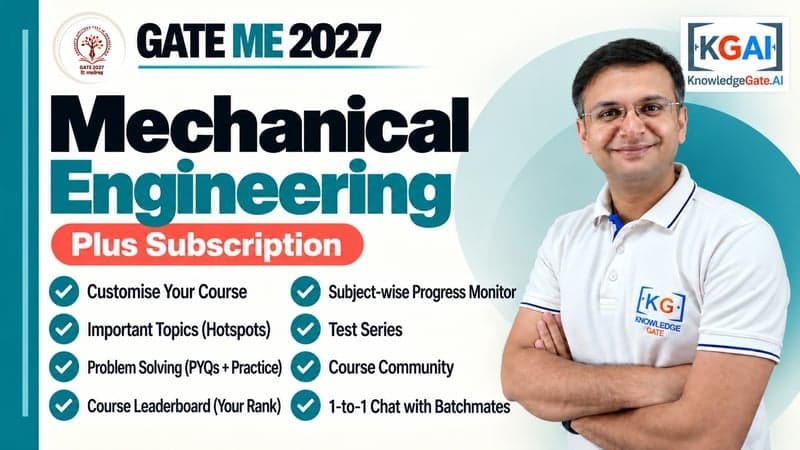
GATE 2027 ME: PYQs with solutions, Engineering Maths, Aptitude, Hotspots and Goal Slider. Plus plan till Jul 2027 or Jul 2028.
Compare GATE 2027 Mechanical Engineering (ME) Complete Course with all courses🎯 GATE 2027 Mechanical Engineering (ME) — Plus Videos help you understand a concept, but watching videos alone isn't enough to get selected. The competition is very high. KnowledgeGate is built on a few simple ideas that give you the edge: 🤖 How the platform helps you Goal Slider: set your target score for your category, and get an exact daily plan: how many questions, which topics, what difficulty. Syllabus Hotspots: see which units and topics are asked most, from real PYQ data, so you study what matters first. Progress Monitor: find where you're losing marks, topic by topic. Leaderboard: see where you stand among other aspirants. Battles: compete with other aspirants on live questions. Community: discuss and prepare together with fellow aspirants. One-to-one chat: ask your doubts directly. Course Captain: a mentor who keeps your preparation on track. Why this matters: most coaching institutes still don't use technology in education. They run on old, outdated systems. KnowledgeGate is very aggressive on AI and technology, and we update the platform regularly, so you get tools at this level for your preparation. 📚 What's inside 1,500+ GATE ME PYQs from recent papers, with solutions, arranged by the official GATE ME syllabus. Engineering Mathematics and General Aptitude, the two sections common to every GATE paper. Practice questions from other exams on the same topics, tagged by source. 📝 GATE at a glance One CBT · 65 questions · 100 marks (General Aptitude 15) · 3 hours · negative marking on MCQs only · GATE 2027: Feb 2027 (expected). 💳 Plus plan Every PYQ and practice question, solutions, all AI tools, the community and your Course Captain. Valid till 31 Jul 2027 (GATE 2027) or 31 Jul 2028 (GATE 2028).
Select Your Plan
Compare plansPlus includes
- Notes & PDFs · Download
- PYQs · Unlimited
- Practice Questions · Unlimited
- Video Solutions · 5 / day
- Test Series · All tests as per academic calendar
- Progress Monitor
What you get
- Validity
- Until 31 Jul 2027
Course Curriculum
Materials, Manufacturing and Industrial Engineering
- Materials Manufacturing and Industrial Engineering
- Crystal Structure and Imperfections
- Phase Diagrams and Heat Treatment
- Properties and Applications of Engineering Materials
- Production Planning and Control
- Inventory Control
- Operations Research
- Metal Casting
- Metal Forming and Powder Metallurgy
- Welding and Joining
- Mechanics of Metal Cutting
- Machine Tools and Machining Operations
- Abrasive Machining and Finishing Processes
- Non-Traditional Machining
- Metrology and Inspection
- Computer Aided Manufacturing, Automation and Additive Manufacturing
- Cement Manufacture, Hydration and Types
- Sensors and Transducers
- Statistics
- Numerical Methods
- Single-Variable Calculus
- Probability Distributions
- Special Electrical Machines
Applied Mechanics and Design
- Applied Mechanics and Design
- Force Systems and Equilibrium
- Trusses and Frames
- Friction
- Centroids and Moments of Inertia
- Kinematics and Kinetics of Particles
- Work-Energy and Impulse-Momentum Methods
- Plane Motion of Rigid Bodies
- Design for Static Loading and Theories of Failure
- Fatigue Design
- Bolted, Riveted and Welded Joints
- Shafts, Keys and Couplings
- Springs
- Rolling and Sliding Contact Bearings
- Simple Stress and Strain
- Mechanical Properties and Testing of Materials
- Shear Force and Bending Moment Diagrams
- Bending and Shear Stresses in Beams
- Deflection of Beams
- Torsion of Circular Shafts
- Principal Stresses and Mohr's Circle
- Pressure Vessels
- Columns and Buckling
- Strain Energy and Energy Methods
- Kinematic Chains and Mechanisms
- Velocity and Acceleration Analysis
- Cams and Followers
- Belt, Rope and Chain Drives
- Gears
- Gear Trains
- Dynamic Force Analysis and Flywheels
- Balancing of Rotating and Reciprocating Masses
- Clutches, Brakes and Dynamometers
- Governors
- Gyroscope
- Free Vibration of Single-DOF Systems
- Forced Vibration and Vibration Isolation
- Two-DOF Systems and Critical Speeds
- Automatic Control Systems
- Bolted and Welded Connections
- Analysis of Trusses, Arches and Cables
- Energy Methods
- Structural Dynamics and Earthquake-Resistant Design
- Noise Pollution and Environmental Management
- Speed, Time and Distance
- Controllers and Industrial Control
Fluid Mechanics and Thermal Sciences
- Fluid Mechanics and Thermal Sciences
- Gas Power Cycles
- Power Plant Engineering
- Internal Combustion Engines
- Air Compressors
- Refrigeration and Air Conditioning
- Renewable Energy Sources
- Fluid Properties
- Fluid Statics
- Fluid Kinematics
- Fluid Dynamics
- Viscous Flow and Boundary Layer
- Flow Through Pipes
- Dimensional Analysis and Similitude
- Compressible Flow
- Hydraulic Turbines and Pumps
- Heat Conduction
- Convective Heat Transfer
- Radiation Heat Transfer
- Heat Exchangers
- Basic Concepts and First Law of Thermodynamics
- Second Law, Entropy and Availability
- Properties of Pure Substances and Gases
- Carrier Transport
- Magnetic Forces and Torque
- Vector Calculus
- Complex Variables
- Rotating Machine Fundamentals
- Reflection and Refraction of Plane Waves
Engineering Mathematics
- Engineering Mathematics
- Linear Algebra
- Engineering Mathematics
- State-Space Analysis
- Transforms, Fourier Series and Partial Differential Equations
- Ordinary Differential Equations
- Probability
- Multivariable Calculus
- Random Variables
- Trigonometry
- Statistics
- Algebra
- Continuous and Joint Distributions
- Effective Stress and Capillarity
- Building Stones, Bricks and Lime
- Index Properties and Classification
- Highway Planning and Alignment
- Deep Foundations
- Steel and Construction Metals
- Rigid Pavement Design
- Compass Surveying
- Fourier Series and Partial Differential Equations
- Traffic Signs, Markings and Signal Design
- Numerical Methods
- Secondary and Tertiary Treatment
- Bituminous Binders and Mix Design
- Differential Calculus
- Compressibility and Consolidation
- Photogrammetry
- Plane Table Surveying
- Aggregates and Water for Concrete
- Fresh Concrete and Concreting Operations
- Subsurface Investigation
- Fundamentals of Surveying
- Shear Strength and Soil Behaviour
- Traffic Flow Theory and Highway Capacity
- Earth Pressure and Retaining Structures
- Complex Variables
- Soil Formation and Phase Relationships
- Intersections and Interchanges
- Shallow Foundation Design
- Seepage and Flow Nets
- Vocabulary
- Remote Sensing
- Topographic Surveying and Cartography
- Air Pollutants, Effects and Meteorology
- Sedimentation and Coagulation
- Vector Calculus
- Railway Geometric Design
- Horizontal and Vertical Alignment of Highways
- Shear Strength Testing
- Traffic Studies and Surveys
- Levelling
- Compaction of Soils
- Filtration
- Theodolite Surveying
- Water Softening and Advanced Treatment
- Bearing Capacity
- Timber, Glass, Plastics and Paints
- Masonry and Building Elements
- Ground Improvement
- Highway Cross-Sections and Sight Distance
- Water Quality Parameters and Standards
- Disinfection
- Sludge Treatment and Disposal
- Integral Calculus
- Discrete Random Variables and Distributions
- Wastewater Characteristics
- Railway Track and Permanent Way
- Stress Distribution in Soils
- Project Monitoring, Resources and Safety
- Highway Construction, Drainage and Maintenance
- Linear Algebra
- Probability
- Linear Algebra
- Probability
- Ordinary Differential Equations
General Aptitude
- Number System
- Series (Number and Letter Series) (Numerical Relations and Reasoning)
- Algebra
- Probability
- Set Theory
- Non Verbal Reasoning (Spatial Aptitude) (Spatial Reasoning) (Visual Reasoning)
- Mensuration and Geometry
- Vocabulary
- Logarithm
- Deductive and Inductive Reasoning (Logical Deduction and Induction) (Prepositional Reasoning)
- Preposition
- Comprehension / Reading Comprehension / Unseen Passages (Critical Reasoning) (Paragraph Questions)
- Seating Arrangements
- Directions (Direction Test)
- Syllogisms
- Permutation and Combination
- Average
- Ranking, Order and Sequence
- Calculus
- Powers and Exponents (Surds and Indices)
- Coding Decoding
- Sequence and Series (Series)
- Statistics
- Profit and Loss
- Trigonometry
- Articles
- Selection Decision Table (Decision Making)
- Analogy and Classification
- Articles and Determiners
- Alphabet and Word Tests
- Simplification and Approximation
- Sequences and Series
- Number System
- Mathematical Operations
- Powers, Surds and Logarithms
- Numerical Reasoning
- Series Completion
- Percentages
- Patterns in Two-Dimensional Figures
- Coding and Decoding
- Ratio and Proportion
- Transformation of Shapes
- Idioms and Phrases
- Voice and Reported Speech
- Prepositions and Conjunctions
- Modals, Conditionals and Subjunctive
- Sentence Basics, Nouns and Pronouns
- Adjectives and Adverbs
- Sentence Structure and Correction
- Verb Forms and Verb Patterns
- Subject-Verb Agreement
- Assembling and Grouping of Shapes
- Three-Dimensional Patterns and Visualization
- Cubes and Dice
- Mensuration
- Measurement and Quantity Take-Off
- Reading Comprehension
- Constraint Puzzles
- Logical Deduction and Induction
- Order, Ranking and Sequence
- Critical Reasoning
- Syllogisms and Venn Diagrams
- Profit, Loss and Discount
- Data Sufficiency
- Direction Sense
- Traverse Surveying
- Clocks and Calendars
- Narrative Sequencing
- Differential Calculus
- Blood Relations
- Tenses
- Data Interpretation
- Time and Work
- Algebra
- Speed, Time and Distance
- Trigonometry
- Probability
- Statistics
- Vocabulary
- Simple Interest and Compound Interest
- Calendar
- Speed Time and Distance
- HCF LCM
- Arithmetic
- Cubes & Dices
- Venn Diagram
- Combinatorics
- Averages, Mixtures and Alligation
- Permutations and Combinations
- Sentence Completion
- Geometry
Instructors
Sanchit Jain
Frequently Asked Questions
This course covers GATE Mechanical Engineering preparation through recent GATE ME PYQs with solutions, arranged by the official ME syllabus. It also includes Engineering Mathematics, General Aptitude and practice questions from other examinations on the same topics. The Plus plan includes the question bank, solutions, AI tools, community and Course Captain.
Yes. The course includes 1,500+ GATE Mechanical Engineering PYQs from recent papers with solutions. They are arranged according to the official GATE ME syllabus for topic-wise preparation. Practice questions from other examinations on the same topics are also included, with the source tagged for context.
Yes. Engineering Mathematics and General Aptitude are included as the common sections of the GATE paper. Alongside them, the course provides Mechanical Engineering PYQs and practice questions from other examinations on the same topics, so the common and branch preparation can be followed together.
The Plus plan includes every PYQ and practice question with solutions, as well as the AI tools, community and Course Captain. The available Plus validity options run until 31 July 2027 or 31 July 2028.
GATE is one computer-based test with 65 questions, 100 marks and three hours. General Aptitude contributes 15 marks, while negative marking applies to MCQs only. GATE 2027 is expected in February 2027.
The Goal Slider allows you to set your target and automatically personalizes your learning plan. Based on your goal, the platform adjusts the number of lessons, practice questions, and difficulty level, helping you prepare more efficiently.
Paper I evaluates candidates on General Knowledge & Awareness, General Intelligence & Reasoning, Numerical Ability, and English Language. These sections assess a candidate's aptitude and problem-solving abilities.
Paper II focuses on professional Computer Science knowledge. It tests candidates on core technical subjects relevant to Computer Science and Information Technology, making technical preparation an essential part of the recruitment process.
A balanced approach works best. Understanding theory is essential, but applying those concepts through questions helps strengthen retention and exam readiness. Many aspirants find it helpful to study a topic and immediately solve related problems before moving ahead.
KnowledgeGate AI is an AI-powered learning platform designed for Computer Science students preparing for competitive exams, placements, and career growth. The platform combines expert guidance, structured learning paths, practice questions, mock tests, and performance analytics to help learners prepare more effectively.
What Our Students Say
Real results, in our students' own words.