GATE 2027 Electronics and Communication Engineering (EC) Complete Course
GATE 2027 Electronics and Communication Engineering (EC) course
Need help choosing this course?
Our counsellor will help with pricing, syllabus, and enrollment.
About GATE 2027 Electronics and Communication Engineering (EC) Complete Course
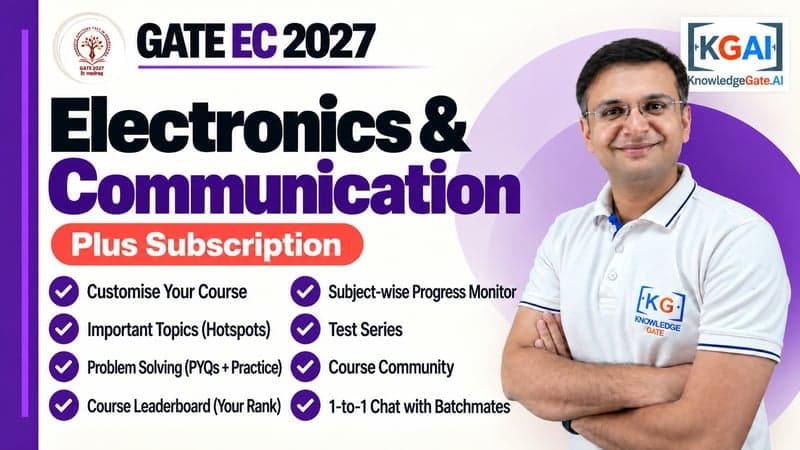
GATE 2027 EC: PYQs with solutions, Engineering Maths, Aptitude, Hotspots and Goal Slider. Plus plan till Jul 2027 or Jul 2028.
Compare GATE 2027 Electronics and Communication Engineering (EC) Complete Course with all courses🎯 GATE 2027 Electronics & Communication Engineering (EC) — Plus Videos help you understand a concept, but watching videos alone isn't enough to get selected. The competition is very high. KnowledgeGate is built on a few simple ideas that give you the edge: 🤖 How the platform helps you Goal Slider: set your target score for your category, and get an exact daily plan: how many questions, which topics, what difficulty. Syllabus Hotspots: see which units and topics are asked most, from real PYQ data, so you study what matters first. Progress Monitor: find where you're losing marks, topic by topic. Leaderboard: see where you stand among other aspirants. Battles: compete with other aspirants on live questions. Community: discuss and prepare together with fellow aspirants. One-to-one chat: ask your doubts directly. Course Captain: a mentor who keeps your preparation on track. Why this matters: most coaching institutes still don't use technology in education. They run on old, outdated systems. KnowledgeGate is very aggressive on AI and technology, and we update the platform regularly, so you get tools at this level for your preparation. 📚 What's inside 1,300+ GATE EC PYQs from recent papers, with solutions, arranged by the official GATE EC syllabus. Engineering Mathematics and General Aptitude, the two sections common to every GATE paper. Practice questions from other exams on the same topics, tagged by source. 📝 GATE at a glance One CBT · 65 questions · 100 marks (General Aptitude 15) · 3 hours · negative marking on MCQs only · GATE 2027: Feb 2027 (expected). 💳 Plus plan Every PYQ and practice question, solutions, all AI tools, the community and your Course Captain. Valid till 31 Jul 2027 (GATE 2027) or 31 Jul 2028 (GATE 2028).
Select Your Plan
Compare plansPlus includes
- Notes & PDFs · Download
- PYQs · Unlimited
- Practice Questions · Unlimited
- Video Solutions · 5 / day
- Test Series · All tests as per academic calendar
- Progress Monitor
What you get
- Validity
- Until 31 Jul 2027
Course Curriculum
Engineering Mathematics
- Engineering Mathematics
- Algebra
- Linear Algebra
- Calculus
- Probability
- Noise in Communication Systems
- Random Processes
- Impedance Matching and Microwave Networks
- Two-Port Networks
- Numerical Methods
- Basic Circuit Concepts and Kirchhoff's Laws
- FET Biasing and Amplifiers
- Random Variables
- Information Theory and Source Coding
- Nyquist Stability and Stability Margins
- Differential Calculus
- Partial Differentiation and Multiple Integrals
- Geodetic Control, Triangulation and GNSS
- Complex Analysis
- Integral Calculus
- Ordinary Differential Equations
- Vector Analysis
- Measurement Principles and Error Analysis
- Statistics
- Probability Distributions
- Operational Amplifier Fundamentals
- Partial Differential Equations
- Optical Fibers
- Laplace Transform and s-Domain Analysis
- System Properties and LTI Systems
- BJT Biasing and Small-Signal Amplifiers
- Frequency Response, Group Delay and Phase Delay
- Minimization of Boolean Functions
- Sinusoidal Steady-State Analysis
- Waveform Generators and Timer Circuits
- Electrostatics
- Registers and Counters
- Carrier Transport
- Root Locus Analysis
- Frequency Response Analysis
- Wireless, Satellite and Optical Communication Systems
- State-Space Analysis
- Superheterodyne Receivers and Phase-Locked Loops
- Stability and Routh-Hurwitz Analysis
- Z-Transform
- Signal Space and Optimum Detection
- Sampling and Reconstruction
- Finite State Machines
- Waveguides
- Reflection and Refraction of Plane Waves
- Energy Bands and Semiconductor Materials
- Time-Varying Fields and Maxwell's Equations
- MOS Capacitor
- Optoelectronic Devices
- Steady-State Error Analysis
- Block Diagrams and Signal Flow Graphs
- Continuous-Time Fourier Transform
- Discrete-Time Fourier Transform, DFT and FFT
- Microprocessors and Microcontrollers
- Antennas
- Bipolar Junction Transistor (BJT)
- Time Response Analysis
- Amplitude Modulation
- Data Converters
- Combinational Logic Design
- Arithmetic Circuits
- Digital Modulation
- Carrier Statistics and Equilibrium Concentration
- Excess Carriers, Recombination and Continuity
- Magnetostatics
- Processor Organization and Instructions
- Probability
- Linear Algebra
- Probability
Networks, Signals and Systems
- Networks Signals and Systems
- Conductors, Dielectrics and Capacitance
- DC Generators
- Coulomb's Law and Electric Field Intensity
- DC Motors
- Three-Phase Induction Motors
- Voltage and Current Measurement
- Power and Power Factor Measurement
- Resistance Measurement and DC Bridges
- Sensors and Transducers
- Network Theorems
- Nodal, Mesh and Network Graph Analysis
- Timing, Hazards and Testing
- Measurement of Non-Electrical Quantities
- Synchronous Motors
- MOSFET
- AC Bridges and Q-Meter
- Renewable Generation and Smart Grids
- Analog Measuring Instruments
- Electrical Engineering Materials
- Protective Relaying
- Distribution Systems and Substations
- Transformer Testing, Regulation and Efficiency
- Resonance
- Current Mirrors and Differential Amplifiers
- Synchronous Generators
- Pulse Modulation and Pulse Code Modulation
- Transformer Principles and Equivalent Circuit
- Transient Analysis of Circuits
- P-N Junction Diode
- Energy Measurement
- Switchgear and Power System Transients
- Uniform Plane Waves
- Induction Motor Starting, Speed Control and Generating Mode
- Rotating Machine Fundamentals
- Electromechanical Energy Conversion
- Transmission Line Fundamentals
- Conventional Power Generation
- Digital Instruments
- Signals: Classification and Operations
- Continuous-Time Fourier Series
- Oscilloscopes and Signal Generators
- Phase, Time and Frequency Measurement
- Digital Filter Design
- AC Power Analysis
- Dielectrics and Capacitance
- Frequency Response of Amplifiers
- Multiplexing and Multiple Access
- Baseband Digital Transmission
General Aptitude
- Percentage
- Ratio and Proportion (Ratios)
- Non Verbal Reasoning (Spatial Aptitude) (Spatial Reasoning) (Visual Reasoning)
- Syllogisms
- Comprehension / Reading Comprehension / Unseen Passages (Critical Reasoning) (Paragraph Questions)
- Mensuration and Geometry
- Seating Arrangements
- Speed Time and Distance
- Permutation and Combination
- Puzzle Solving (Puzzles)
- Preposition
- Vocabulary
- Logarithm
- Number System
- Deductive and Inductive Reasoning (Logical Deduction and Induction) (Prepositional Reasoning)
- Sequence and Series (Series)
- Simple Interest and Compound Interest
- Analytical Reasoning (Counting Figures Reasoning)
- Arithmetic
- Series (Number and Letter Series) (Numerical Relations and Reasoning)
- Profit and Loss
- Coding Decoding
- Selection Decision Table (Decision Making)
- Ranking, Order and Sequence
- Logical Sequence Of Words
- Permutations and Combinations
- Percentages
- Ratio and Proportion
- Averages, Mixtures and Alligation
- Profit, Loss and Discount
- Sequences and Series
- Algebra
- Subject-Verb Agreement
- Sentence Completion
- Reading Comprehension
- Numerical Reasoning
- Patterns in Two-Dimensional Figures
- Assembling and Grouping of Shapes
- Three-Dimensional Patterns and Visualization
- Coding and Decoding
- Cubes and Dice
- Direction Sense
- Analogy and Classification
- Articles and Determiners
- Alphabet and Word Tests
- Sentence Basics, Nouns and Pronouns
- Idioms and Phrases
- Verb Forms and Verb Patterns
- Logical Deduction and Induction
- Syllogisms and Venn Diagrams
- Critical Reasoning
- Mensuration
- Probability
- Measurement and Quantity Take-Off
- Statistics
- Modals, Conditionals and Subjunctive
- Voice and Reported Speech
- Prepositions and Conjunctions
- Narrative Sequencing
- Sentence Structure and Correction
- Order, Ranking and Sequence
- Constraint Puzzles
- Adjectives and Adverbs
- Mathematical Operations
- Simplification and Approximation
- Series Completion
- Data Sufficiency
- Clocks and Calendars
- Project Monitoring, Resources and Safety
- Data Interpretation
- Time and Work
- Vocabulary
- Blood Relations
- Speed, Time and Distance
- Trigonometry
- Tenses
- Mixture and Alligation
- Calendar
- Cubes & Dices
- Venn Diagram
- Combinatorics
- Geometry
- Number System
- Powers, Surds and Logarithms
- Transformation of Shapes
Electronic Devices
- Electronic Devices
- IC Fabrication Technology
- Logic Families and CMOS Logic
- Special Semiconductor Devices
- Magnetic Materials
- Junction and Heterojunction Field-Effect Transistors
- Firing, Gate Drive and Protection Circuits
- Thyristor Commutation
- Power Semiconductor Devices
- Diode Circuits
- Rectifiers and Power Supplies
Digital Circuits
- Digital Circuits
- Sequential Circuits
- Programming the Basic Computer
- Boolean Minimization
- Number System
- Logic Gates & Hardware
- Combinational Circuit
- Cache Memory Organization
- Boolean Expression
- Number Systems and Codes
- Boolean Algebra and Logic Gates
- Semiconductor Memories and Programmable Logic
- Memory Hierarchy and Input/Output
- Latches and Flip-Flops
- Instruction Pipelining
- Linear Algebra
- Sequential Circuits and State Machines
- Registers and Counters
- Minimization of Boolean Functions
- Logic Gates and Boolean Algebra
- Logic Families
- Combinational Logic Circuits
- Latches and Flip-Flops
- Semiconductor Memories and Programmable Logic Devices
- Number Systems and Codes
Communications
- Communications
- Feedback Amplifiers
- Communication Fundamentals and Bandpass Signals
- Angle Modulation
- Sinusoidal Oscillators
- Error Control Coding
- Analog Filter Circuits
Control Systems
- Control Systems
- Control System Fundamentals and Modeling
- Industrial Controllers
- Control System Compensation
- DC-DC Converters and Choppers
- Load Characteristics and Power Economics
- Autotransformers and Three-Phase Transformers
- DC Machine Fundamentals
- Stability and Routh-Hurwitz Criterion
- Digital Control Systems
- Time Response Analysis
- State-Space Analysis
- Microprocessors
- Block Diagrams and Signal Flow Graphs
Analog Circuits
- Analog Circuits
- Linear Op-Amp Applications
- Nonlinear Op-Amp Applications
- Multistage Amplifiers and Output Stages
- Switched-Mode Power Supplies and UPS
- Phase-Controlled Rectifiers
- Uncontrolled Rectifiers
Electromagnetics
- Electromagnetics
- Transmission Line Parameters and Construction
- Instrument Transformers
- Radio Links and Propagation
- Maxwell's Equations and Electromagnetic Waves
- AC Transmission Line Performance
Instructors
Sanchit Jain
Frequently Asked Questions
This course covers GATE Electronics and Communication Engineering preparation through recent GATE EC PYQs with solutions, arranged by the official EC syllabus. It also includes Engineering Mathematics, General Aptitude and practice questions from other examinations on the same topics. The Plus plan includes questions, solutions, AI tools, community and Course Captain.
Yes. The course includes 1,300+ GATE Electronics and Communication Engineering PYQs from recent papers with solutions. They are organised according to the official GATE EC syllabus. Practice questions from other examinations on the same topics are also available, and their source is tagged for reference.
Yes. Engineering Mathematics and General Aptitude are included as the two sections common to every GATE paper. The course combines those sections with Electronics and Communication PYQs and practice questions from other examinations on the same topics for branch-focused preparation.
The Plus plan includes every PYQ and practice question with solutions, together with the AI tools, the community and Course Captain. The available Plus validity options run until 31 July 2027 or 31 July 2028.
GATE is one computer-based test with 65 questions, 100 marks and three hours. General Aptitude carries 15 marks, and negative marking applies to MCQs only. GATE 2027 is expected in February 2027.
The Goal Slider allows you to set your target and automatically personalizes your learning plan. Based on your goal, the platform adjusts the number of lessons, practice questions, and difficulty level, helping you prepare more efficiently.
Paper I evaluates candidates on General Knowledge & Awareness, General Intelligence & Reasoning, Numerical Ability, and English Language. These sections assess a candidate's aptitude and problem-solving abilities.
Paper II focuses on professional Computer Science knowledge. It tests candidates on core technical subjects relevant to Computer Science and Information Technology, making technical preparation an essential part of the recruitment process.
A balanced approach works best. Understanding theory is essential, but applying those concepts through questions helps strengthen retention and exam readiness. Many aspirants find it helpful to study a topic and immediately solve related problems before moving ahead.
KnowledgeGate AI is an AI-powered learning platform designed for Computer Science students preparing for competitive exams, placements, and career growth. The platform combines expert guidance, structured learning paths, practice questions, mock tests, and performance analytics to help learners prepare more effectively.
What Our Students Say
Real results, in our students' own words.