

GATE 2027 Electrical Engineering (EE) Complete Course
GATE 2027 Electrical Engineering (EE) course
Need help choosing this course?
Our counsellor will help with pricing, syllabus, and enrollment.
About GATE 2027 Electrical Engineering (EE) Complete Course
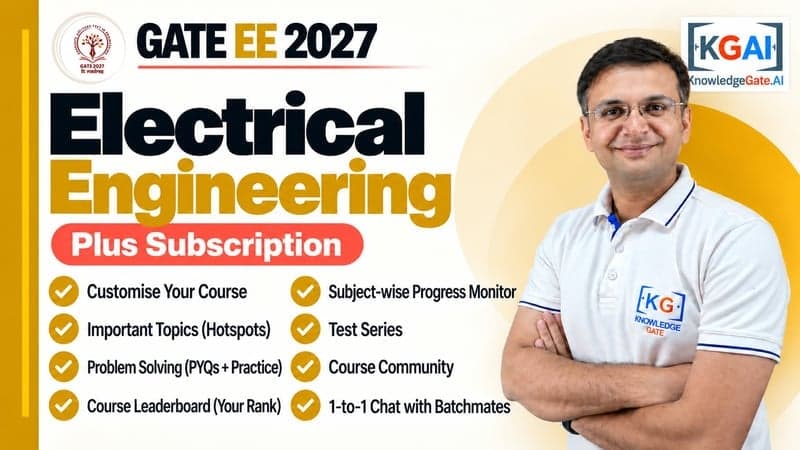
GATE 2027 EE: PYQs with solutions, Engineering Maths, Aptitude, Hotspots and Goal Slider. Plus plan till Jul 2027 or Jul 2028.
Compare GATE 2027 Electrical Engineering (EE) Complete Course with all courses🎯 GATE 2027 Electrical Engineering (EE) — Plus Videos help you understand a concept, but watching videos alone isn't enough to get selected. The competition is very high. KnowledgeGate is built on a few simple ideas that give you the edge: 🤖 How the platform helps you Goal Slider: set your target score for your category, and get an exact daily plan: how many questions, which topics, what difficulty. Syllabus Hotspots: see which units and topics are asked most, from real PYQ data, so you study what matters first. Progress Monitor: find where you're losing marks, topic by topic. Leaderboard: see where you stand among other aspirants. Battles: compete with other aspirants on live questions. Community: discuss and prepare together with fellow aspirants. One-to-one chat: ask your doubts directly. Course Captain: a mentor who keeps your preparation on track. Why this matters: most coaching institutes still don't use technology in education. They run on old, outdated systems. KnowledgeGate is very aggressive on AI and technology, and we update the platform regularly, so you get tools at this level for your preparation. 📚 What's inside 1,000+ GATE EE PYQs from recent papers, with solutions, arranged by the official GATE EE syllabus. Engineering Mathematics and General Aptitude, the two sections common to every GATE paper. Practice questions from other exams on the same topics, tagged by source. 📝 GATE at a glance One CBT · 65 questions · 100 marks (General Aptitude 15) · 3 hours · negative marking on MCQs only · GATE 2027: Feb 2027 (expected). 💳 Plus plan Every PYQ and practice question, solutions, all AI tools, the community and your Course Captain. Valid till 31 Jul 2027 (GATE 2027) or 31 Jul 2028 (GATE 2028).
Select Your Plan
Compare plansPlus includes
- Notes & PDFs · Download
- PYQs · Unlimited
- Practice Questions · Unlimited
- Video Solutions · 5 / day
- Test Series · All tests as per academic calendar
- Progress Monitor
What you get
- Validity
- Until 31 Jul 2027
Course Curriculum
Engineering Mathematics
- Engineering Mathematics
- Probability
- Linear Algebra
- Converter-Fed Electric Drives
- Synchronous Motors
- Microprocessors
- Vector Calculus
- Three-Phase Induction Motors
- Minimization of Boolean Functions
- AC Transmission Line Performance
- Resistance Measurement and DC Bridges
- Steady Magnetic Field
- Z-Transform
- Numerical Methods
- Transformer Testing, Regulation and Efficiency
- Logic Gates and Boolean Algebra
- Transformer Principles and Equivalent Circuit
- Circuit Laws and Analysis Methods
- Phase, Time and Frequency Measurement
- Electrical Engineering Materials
- Fourier Series
- Differential Calculus
- Registers and Counters
- Block Diagrams and Signal Flow Graphs
- Circuit Elements and Sources
- Instrument Transformers
- Partial Derivatives and Multiple Integrals
- Economic Load Dispatch and Frequency Control
- Laplace Transform
- Symmetrical Components and Fault Analysis
- Differential Equations
- Magnetic Materials
- LTI Systems and Convolution
- Transmission Line Parameters and Construction
- Complex Variables
- Dielectrics and Capacitance
- Stability and Routh-Hurwitz Criterion
- Power and Power Factor Measurement
- Random Variables
- Continuous-Time Fourier Transform
- Network Theorems
- Integral Calculus
- Trigonometry and Coordinate Geometry
- Probability Distributions and Random Processes
- Information Theory and Source Coding
- Pulse Modulation and Pulse Code Modulation
- Magnetic Forces and Torque
- Sampling and Reconstruction
- Statistics
- Signal Space and Optimum Detection
- Probability
- Probability
General Aptitude
- Non Verbal Reasoning (Spatial Aptitude) (Spatial Reasoning) (Visual Reasoning)
- Number System
- Ratio and Proportion (Ratios)
- Preposition
- Mensuration and Geometry
- Sequence and Series (Series)
- Permutation and Combination
- Comprehension / Reading Comprehension / Unseen Passages (Critical Reasoning) (Paragraph Questions)
- Arithmetic
- Ranking, Order and Sequence
- Algebra
- Venn Diagram
- Powers and Exponents (Surds and Indices)
- Coding Decoding
- Statistics
- Series (Number and Letter Series) (Numerical Relations and Reasoning)
- Vocabulary
- Syllogisms
- Deductive and Inductive Reasoning (Logical Deduction and Induction) (Prepositional Reasoning)
- Analytical Reasoning (Counting Figures Reasoning)
- Calculus
- Seating Arrangements
- Number System
- Miscellaneous
- Analogy and Classification
- Articles and Determiners
- Sentence Completion
- Blood Relations
- Alphabet and Word Tests
- Numerical Reasoning
- Patterns in Two-Dimensional Figures
- Assembling and Grouping of Shapes
- Three-Dimensional Patterns and Visualization
- Cubes and Dice
- Mathematical Operations
- Direction Sense
- Simplification and Approximation
- Sequences and Series
- Powers, Surds and Logarithms
- Averages, Mixtures and Alligation
- Profit, Loss and Discount
- Ratio and Proportion
- Percentages
- Subject-Verb Agreement
- Geometry
- Reading Comprehension
- Idioms and Phrases
- Prepositions and Conjunctions
- Sentence Basics, Nouns and Pronouns
- Verb Forms and Verb Patterns
- Sentence Structure and Correction
- Mensuration
- Permutations and Combinations
- Probability
- Measurement and Quantity Take-Off
- Wireless, Satellite and Optical Communication Systems
- Differential Calculus
- Narrative Sequencing
- Critical Reasoning
- Data Sufficiency
- Constraint Puzzles
- Clocks and Calendars
- Order, Ranking and Sequence
- Voice and Reported Speech
- Modals, Conditionals and Subjunctive
- Syllogisms and Venn Diagrams
- Coding and Decoding
- Adjectives and Adverbs
- Series Completion
- Logical Deduction and Induction
- Number Systems and Codes
- Combinational Logic Design
- Building Stones, Bricks and Lime
- Building Planning, Foundations and Temporary Works
- Project Monitoring, Resources and Safety
- Construction Equipment
- Estimates, Rate Analysis and Valuation
- Phase-Controlled Rectifiers
- Multiplexing and Multiple Access
- Inverters
- Sensors and Transducers
- Vocabulary
- Number System
- Algebra
- Time and Work
- Data Interpretation
- Trigonometry
- Speed, Time and Distance
- Statistics
- Tenses
- Number Systems and Codes
- Simple Interest and Compound Interest
- Mixture and Alligation
- Calendar
- Speed Time and Distance
- HCF LCM
- Profit and Loss
- Cubes & Dices
- Combinatorics
- Transformation of Shapes
Electrical Machines
- Electrical Machines
- Autotransformers and Three-Phase Transformers
- Power System Representation and Load Flow
- Switched-Mode Power Supplies and UPS
- Distribution Systems and Substations
- Electromechanical Energy Conversion
- Inductance and Magnetic Energy
- DC Motors
- Time Response Analysis
- DC Generators
- DC Machine Fundamentals
- Rotating Machine Fundamentals
- Special Electrical Machines
- Electromagnetic Induction
- Induction Motor Starting, Speed Control and Generating Mode
- Single-Phase Induction Motors
- Synchronous Generators
- Power-Angle Characteristics and Parallel Operation
- Power System Stability
- Energy Measurement
- State-Space Analysis
Power Systems
- Power Systems
- Load Characteristics and Power Economics
- Conventional Power Generation
- Renewable Generation and Smart Grids
- Switchgear and Power System Transients
- Protective Relaying
- Reactive Power and Voltage Control
- Transmission Line Fundamentals
- Three-Phase and Polyphase Circuits
- Contracts and Tendering
- Underground Cables
- Measurement of Non-Electrical Quantities
- HVDC Transmission
- Maxwell's Equations and Electromagnetic Waves
- AC Power and Power Factor
Signals and Systems
- Signals and Systems
- Digital Modulation
- Average and RMS Values of Periodic Waveforms
- Frequency Response and Filtering
- Noise in Communication Systems
- Amplitude Modulation
- Signals and Signal Operations
- System Classification and Properties
- Superheterodyne Receivers and Phase-Locked Loops
- Communication Fundamentals and Bandpass Signals
- Digital Control Systems
- Baseband Digital Transmission
- Sinusoidal Steady-State Analysis
- Digital Filters and Pole-Zero Analysis
- Number Systems and Codes
- Angle Modulation
- DTFT, DFT and FFT
- Fourier Series
- Random Processes
- Transient Analysis
- Resonance
- Voltage and Current Measurement
- Analog Measuring Instruments
- Network Functions, Filters and Synthesis
Electric Circuits
- Electric Circuits
- Network Graph Theory and Duality
- Controllers and Industrial Control
- Conductors, Dielectrics and Capacitance
- Measurement Principles and Error Analysis
- AC Bridges and Q-Meter
- Network Theorems
- Two-Port Networks
- Magnetically Coupled Circuits
- System Modelling and Feedback
Analog and Digital Electronics
- Analog Electronics
- Logic Gates & Hardware
- Boolean Minimization
- Sequential Circuits
- Programming the Basic Computer
- Semiconductor Diodes and Diode Circuits
- Bipolar Junction Transistors
- Field-Effect Transistors
- Transistor Amplifiers
- Feedback Amplifiers and Oscillators
- Operational Amplifiers
- Active Filters
- Multivibrators, Timers and VCOs
- Uncontrolled Rectifiers
- Optoelectronic Devices
- Carrier Statistics and Equilibrium Concentration
- Logic Families
- Bipolar Junction Transistor (BJT)
- Digital Filter Design
- Combinational Logic Circuits
- Arithmetic Circuits
- A/D and D/A Converters
- Latches and Flip-Flops
- Sequential Circuits and State Machines
- Semiconductor Memories and Programmable Logic Devices
- Boolean Algebra and Logic Gates
- Timing, Hazards and Testing
- Logic Families and CMOS Logic
- Minimization of Boolean Functions
- Finite State Machines
- Registers and Counters
- Junction and Heterojunction Field-Effect Transistors
- MOSFET
- IC Fabrication Technology
- FET Biasing and Amplifiers
- MOS Capacitor
- Microprocessors and Microcontrollers
- Arithmetic Circuits
- Latches and Flip-Flops
- Number Systems and Codes
Power Electronics
- Power Electronics
- Converter Fundamentals and Waveform Analysis
- Firing, Gate Drive and Protection Circuits
- Power Semiconductor Devices
- Thyristor Commutation
- AC Voltage Controllers
- Rectifier Harmonics and Input Performance
- DC-DC Converters and Choppers
- Resonant Converters
Control Systems
- Control Systems
- Automatic Control Systems
- Steady-State Error Analysis
- Frequency Response and Bode Plots
- Polar Plots and Nyquist Stability
- Root Locus
- Lead, Lag and Lead-Lag Compensation
Electromagnetic Fields
- Electromagnetic Fields
- Electric Flux Density and Gauss's Law
- Conductors and Boundary-Value Problems
- Coulomb's Law and Electric Field Intensity
- Electric Potential and Energy
- Magnetic Materials
- Magnetic Circuits
- Waveguides
- Reflection and Refraction of Plane Waves
Electrical and Electronic Measurements
- Electrical and Electronic Measurements
- Potentiometers
- Oscilloscopes and Signal Generators
- Digital Instruments
Instructors
Sanchit Jain
Frequently Asked Questions
This course covers GATE Electrical Engineering preparation through recent GATE EE PYQs with solutions, arranged by the official EE syllabus. It also includes Engineering Mathematics, General Aptitude and practice questions from other examinations on the same topics. The Plus plan includes the question bank, solutions, AI tools, community and Course Captain.
Yes. The course includes 1,000+ GATE Electrical Engineering PYQs from recent papers with solutions. They are arranged according to the official GATE EE syllabus for topic-wise preparation. Practice questions from other examinations on the same topics are also included, with their source tagged.
Yes. Engineering Mathematics and General Aptitude are included because they are common sections of the GATE paper. Alongside them, the course provides Electrical Engineering PYQs and practice questions from other examinations on the same topics, allowing common and branch preparation in one course.
The Plus plan provides every PYQ and practice question with solutions, plus the AI tools, community and Course Captain. The available Plus validity options run until 31 July 2027 or 31 July 2028.
GATE is one computer-based test with 65 questions, 100 marks and a three-hour duration. General Aptitude contributes 15 marks, and negative marking applies to MCQs only. The GATE 2027 examination timing is shown as February 2027 (expected).
The Goal Slider allows you to set your target and automatically personalizes your learning plan. Based on your goal, the platform adjusts the number of lessons, practice questions, and difficulty level, helping you prepare more efficiently.
Paper I evaluates candidates on General Knowledge & Awareness, General Intelligence & Reasoning, Numerical Ability, and English Language. These sections assess a candidate's aptitude and problem-solving abilities.
Paper II focuses on professional Computer Science knowledge. It tests candidates on core technical subjects relevant to Computer Science and Information Technology, making technical preparation an essential part of the recruitment process.
A balanced approach works best. Understanding theory is essential, but applying those concepts through questions helps strengthen retention and exam readiness. Many aspirants find it helpful to study a topic and immediately solve related problems before moving ahead.
KnowledgeGate AI is an AI-powered learning platform designed for Computer Science students preparing for competitive exams, placements, and career growth. The platform combines expert guidance, structured learning paths, practice questions, mock tests, and performance analytics to help learners prepare more effectively.
What Our Students Say
Real results, in our students' own words.


