GATE 2027 Civil Engineering (CE) Complete Course
GATE 2027 Civil Engineering (CE) course
Need help choosing this course?
Our counsellor will help with pricing, syllabus, and enrollment.
About GATE 2027 Civil Engineering (CE) Complete Course
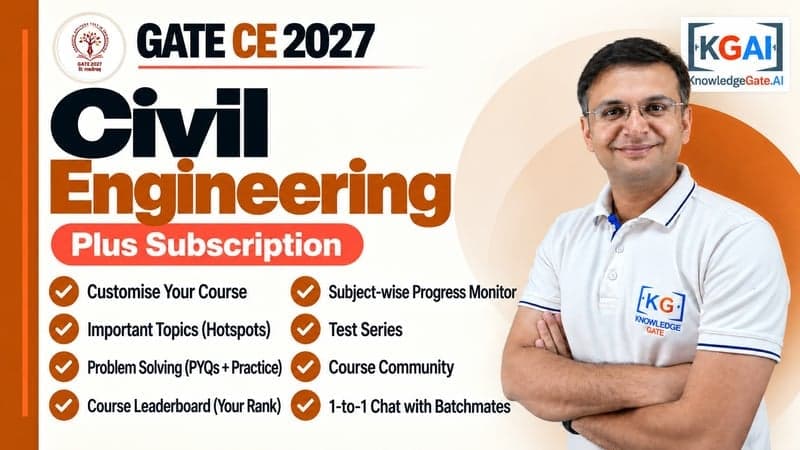
GATE 2027 Civil Engineering: branch PYQs with solutions, Engineering Maths, Aptitude, Syllabus Hotspots and Goal Slider. Plus plan till Jul 2027 or Jul 2028.
Compare GATE 2027 Civil Engineering (CE) Complete Course with all courses🎯 GATE 2027 Civil Engineering (CE) — Plus Videos help you understand a concept, but watching videos alone isn't enough to get selected. The competition is very high. KnowledgeGate is built on a few simple ideas that give you the edge: 🤖 How the platform helps you Goal Slider: set your target score for your category, and get an exact daily plan: how many questions, which topics, what difficulty. Syllabus Hotspots: see which units and topics are asked most, from real PYQ data, so you study what matters first. Progress Monitor: find where you're losing marks, topic by topic. Leaderboard: see where you stand among other aspirants. Battles: compete with other aspirants on live questions. Community: discuss and prepare together with fellow aspirants. One-to-one chat: ask your doubts directly. Course Captain: a mentor who keeps your preparation on track. Why this matters: most coaching institutes still don't use technology in education. They run on old, outdated systems. KnowledgeGate is very aggressive on AI and technology, and we update the platform regularly, so you get tools at this level for your preparation. 📚 What's inside 1,600+ GATE CE PYQs from recent papers, with solutions, arranged by the official GATE CE syllabus. Engineering Mathematics and General Aptitude, the two sections common to every GATE paper. Practice questions from other exams on the same topics, tagged by source. 📝 GATE at a glance One CBT · 65 questions · 100 marks (General Aptitude 15) · 3 hours · negative marking on MCQs only · GATE 2027: Feb 2027 (expected). 💳 Plus plan Every PYQ and practice question, solutions, all AI tools, the community and your Course Captain. Valid till 31 Jul 2027 (GATE 2027) or 31 Jul 2028 (GATE 2028).
Select Your Plan
Compare plansPlus includes
- Notes & PDFs · Download
- PYQs · Unlimited
- Practice Questions · Unlimited
- Video Solutions · 5 / day
- Test Series · All tests as per academic calendar
- Progress Monitor
What you get
- Validity
- Until 31 Jul 2027
Course Curriculum
Structural Engineering
- Structural Engineering
- Concrete Design Philosophies and Loads
- Design of RC Beams
- Bond, Detailing and Serviceability
- RC Slabs and Staircases
- RC Columns and Footings
- Retaining Walls, Tanks and Masonry Design
- Prestressed Concrete
- Engineering Mechanics
- Simple Stress and Strain
- Transformation of Stress and Strain
- Shear Force and Bending Moment
- Bending and Shear Stresses in Beams
- Deflection of Beams
- Torsion of Shafts and Springs
- Columns and Buckling
- Steel Design Basics
- Plastic Analysis
- Bolted and Welded Connections
- Tension Members
- Compression Members and Column Bases
- Steel Beams and Beam-Columns
- Plate Girders and Roof Trusses
- Determinacy and Stability of Structures
- Analysis of Trusses, Arches and Cables
- Energy Methods
- Analysis of Indeterminate Structures
- Influence Lines and Moving Loads
- Structural Dynamics and Earthquake-Resistant Design
- Production Planning and Control
- Operations Research
- Highway Cross-Sections and Sight Distance
- Traffic Studies and Surveys
- Flexible Pavement Design
- Bridge, Tunnel and Harbour Engineering
- Chain and Tape Surveying
- Compass Surveying
- Shear Strength and Soil Behaviour
- Underground Cables
- Building Stones, Bricks and Lime
- Timber, Glass, Plastics and Paints
- Cement Properties and Tests
- Construction Equipment
- Project Planning and Network Analysis
- Water Quality Parameters and Standards
- Fresh Concrete and Concreting Operations
- Estimates, Rate Analysis and Valuation
- Aggregates and Water for Concrete
- Project Monitoring, Resources and Safety
- Building Finishes and Maintenance
- Measurement and Quantity Take-Off
- Steel and Construction Metals
- Cement Manufacture, Hydration and Types
- Building Planning, Foundations and Temporary Works
- Hardened Concrete Properties
- Special Concretes
- Masonry and Building Elements
- Contracts and Tendering
- Solid Waste Treatment and Disposal
- Ground Improvement
- Concrete Mix Design
- Admixtures for Concrete
- Sludge Treatment and Disposal
- Air Pollutants, Effects and Meteorology
- Deep Foundations
- Traffic Flow Theory and Highway Capacity
- Engineering Surveys, Curves and Earthwork
Engineering Mathematics
- Engineering Mathematics
- Linear Algebra
- Continuous and Joint Distributions
- Effective Stress and Capillarity
- Index Properties and Classification
- Highway Planning and Alignment
- Rigid Pavement Design
- Fourier Series and Partial Differential Equations
- Traffic Signs, Markings and Signal Design
- Numerical Methods
- Secondary and Tertiary Treatment
- Bituminous Binders and Mix Design
- Differential Calculus
- Compressibility and Consolidation
- Photogrammetry
- Plane Table Surveying
- Subsurface Investigation
- Fundamentals of Surveying
- Earth Pressure and Retaining Structures
- Complex Variables
- Soil Formation and Phase Relationships
- Intersections and Interchanges
- Shallow Foundation Design
- Seepage and Flow Nets
- Vocabulary
- Remote Sensing
- Topographic Surveying and Cartography
- Probability
- Sedimentation and Coagulation
- Vector Calculus
- Railway Geometric Design
- Horizontal and Vertical Alignment of Highways
- Shear Strength Testing
- Levelling
- Compaction of Soils
- Filtration
- Theodolite Surveying
- Water Softening and Advanced Treatment
- Bearing Capacity
- Ordinary Differential Equations
- Disinfection
- Integral Calculus
- Discrete Random Variables and Distributions
- Wastewater Characteristics
- Railway Track and Permanent Way
- Stress Distribution in Soils
- Highway Construction, Drainage and Maintenance
- Multivariable Calculus
- Statistics
- Water Demand, Conveyance and Distribution
- Numerical Differential Equations
- Algebra
- Noise Pollution and Environmental Management
- Slope Stability
- Preliminary and Primary Treatment
- Time and Work
- Geodetic Control, Triangulation and GNSS
- Linear Algebra
Geotechnical Engineering
- Geotechnical Engineering
- Permeability
- Highway Subgrade Testing
- Highway Aggregates
General Aptitude
- Vocabulary
- Coding Decoding
- Algebra
- Comprehension / Reading Comprehension / Unseen Passages (Critical Reasoning) (Paragraph Questions)
- Seating Arrangements
- Sequence and Series (Series)
- Preposition
- Mensuration and Geometry
- Non Verbal Reasoning (Spatial Aptitude) (Spatial Reasoning) (Visual Reasoning)
- Venn Diagram
- Deductive and Inductive Reasoning (Logical Deduction and Induction) (Prepositional Reasoning)
- Powers and Exponents (Surds and Indices)
- Probability
- Speed Time and Distance
- Permutation and Combination
- Directions (Direction Test)
- Syllogisms
- Calculus
- Ratio and Proportion (Ratios)
- Statistics
- Puzzle Solving (Puzzles)
- Cubes & Dices
- Percentage
- Series (Number and Letter Series) (Numerical Relations and Reasoning)
- Set Theory
- Arithmetic
- Logarithm
- Profit and Loss
- Idioms and Phrases
- Voice and Reported Speech
- Prepositions and Conjunctions
- Modals, Conditionals and Subjunctive
- Sentence Basics, Nouns and Pronouns
- Adjectives and Adverbs
- Sentence Structure and Correction
- Articles and Determiners
- Verb Forms and Verb Patterns
- Subject-Verb Agreement
- Analogy and Classification
- Reading Comprehension
- Alphabet and Word Tests
- Mathematical Operations
- Coding and Decoding
- Number System
- Sequences and Series
- Ratio and Proportion
- Powers, Surds and Logarithms
- Simplification and Approximation
- Narrative Sequencing
- Critical Reasoning
- Constraint Puzzles
- Averages, Mixtures and Alligation
- Three-Dimensional Patterns and Visualization
- Patterns in Two-Dimensional Figures
- Percentages
- Transformation of Shapes
- Numerical Reasoning
- Assembling and Grouping of Shapes
- Cubes and Dice
- Series Completion
- Direction Sense
- Clocks and Calendars
- Syllogisms and Venn Diagrams
- Logical Deduction and Induction
- Profit, Loss and Discount
- Signal Space and Optimum Detection
- Traverse Surveying
- Wireless, Satellite and Optical Communication Systems
- Differential Calculus
- Tenses
- Blood Relations
- Data Interpretation
- Statistics
- Trigonometry
- Speed, Time and Distance
- Probability
- Data Sufficiency
- Algebra
- Time and Work
- Vocabulary
- Simple Interest and Compound Interest
- Mixture and Alligation
- Calendar
- HCF LCM
- Combinatorics
- Mensuration
- Permutations and Combinations
- Sentence Completion
- Geometry
- Order, Ranking and Sequence
Water Resources Engineering
- Water Resources Engineering
- Fluid Mechanics and Thermal Sciences
- Fluid Properties
- Fluid Statics
- Fluid Kinematics and Potential Flow
- Fluid Dynamics
- Flow Measurement
- Laminar and Turbulent Flow
- Flow Through Pipes
- Boundary Layer, Drag and Lift
- Dimensional Analysis and Hydraulic Similitude
- Hydraulic Turbines and Hydropower
- Hydraulic Pumps
- Uniform Flow in Open Channels
- Specific Energy and Critical Flow
- Gradually Varied Flow
- Hydraulic Jump and Rapidly Varied Flow
- Hydrologic Cycle and Precipitation
- Abstractions from Precipitation
- Streamflow Measurement and Runoff
- Hydrographs
- Floods and Flood Routing
- Groundwater and Well Hydraulics
- Reservoir Planning
- Irrigation Systems and Methods
- Crop Water Requirements
- Irrigation Canals
- Waterlogging and Land Drainage
- Canal Structures and Cross-Drainage Works
- Diversion Headworks and Weirs on Permeable Foundations
- Dams and Spillways
- River Engineering and Training Works
- Power Plant Engineering
- Internal Combustion Engines
- Air Compressors
- Refrigeration and Air Conditioning
- Crystal Structure and Imperfections
- Properties and Applications of Engineering Materials
- Plane Motion of Rigid Bodies
- Fluid Kinematics
- Viscous Flow and Boundary Layer
- Dimensional Analysis and Similitude
- Compressible Flow
- Hydraulic Turbines and Pumps
- Convective Heat Transfer
- Heat Exchangers
- Basic Concepts and First Law of Thermodynamics
- Effluent Disposal and Self-Purification
- Carrier Transport
- Magnetic Forces and Torque
Environmental Engineering
- Environmental Engineering
- Renewable Energy Sources
- Sewerage System Design
- Air Pollution Control
- Linear Algebra
- Solid Waste Characteristics and Collection
- Reflection and Refraction of Plane Waves
Transportation Engineering
- Transportation Engineering
- Airport Engineering
- Transportation Planning and Public Transport
Geomatics Engineering
- Geomatics Engineering
- Construction Materials and Management
- Tacheometry and Total Station Surveying
- Geographic Information Systems
- Errors and Adjustment of Observations
Instructors
Sanchit Jain
Frequently Asked Questions
This course covers GATE Civil Engineering preparation through recent GATE CE PYQs with solutions, arranged by the official CE syllabus. It also includes Engineering Mathematics, General Aptitude and practice questions from other examinations on the same topics. The Plus plan includes the question bank, solutions, AI tools, community and Course Captain.
Yes. The course includes 1,600+ GATE Civil Engineering PYQs from recent papers with solutions. They are arranged according to the official GATE CE syllabus so you can work topic by topic. Practice questions from other examinations on the same topics are also available with their source tagged.
Yes. Engineering Mathematics and General Aptitude are included because they are common sections of the GATE paper. The course also provides Civil Engineering PYQs and topic-based practice questions, allowing you to combine the common sections with your branch preparation in one structured course.
The Plus plan provides every PYQ and practice question with solutions, along with the course AI tools, community and Course Captain. The available Plus validity options run until 31 July 2027 or 31 July 2028.
GATE is one computer-based test with 65 questions, 100 marks and a three-hour duration. General Aptitude contributes 15 marks, and negative marking applies to MCQs only. GATE 2027 is expected in February 2027.
The Goal Slider allows you to set your target and automatically personalizes your learning plan. Based on your goal, the platform adjusts the number of lessons, practice questions, and difficulty level, helping you prepare more efficiently.
Paper I evaluates candidates on General Knowledge & Awareness, General Intelligence & Reasoning, Numerical Ability, and English Language. These sections assess a candidate's aptitude and problem-solving abilities.
Paper II focuses on professional Computer Science knowledge. It tests candidates on core technical subjects relevant to Computer Science and Information Technology, making technical preparation an essential part of the recruitment process.
A balanced approach works best. Understanding theory is essential, but applying those concepts through questions helps strengthen retention and exam readiness. Many aspirants find it helpful to study a topic and immediately solve related problems before moving ahead.
KnowledgeGate AI is an AI-powered learning platform designed for Computer Science students preparing for competitive exams, placements, and career growth. The platform combines expert guidance, structured learning paths, practice questions, mock tests, and performance analytics to help learners prepare more effectively.
What Our Students Say
Real results, in our students' own words.