

DSA using Java
(Crack Product Based Placement)
Need help choosing this course?
Our counsellor will help with pricing, syllabus, and enrollment.
About DSA using Java
Interview-focused DSA course in Java to crack coding rounds and technical interviews at product-based companies.
Compare DSA using Java with all coursesDSA Using Java – Product-Based Placement Preparation Course DSA Using Java Course is a structured and interview-focused programme designed for students and professionals aiming to crack coding rounds and technical interviews at product-based companies. The programme follows a practical, problem-first approach where concepts are taught through real coding problems rather than isolated theory. Students learn how to approach a problem systematically, starting from basic solutions and progressing towards optimised approaches while understanding trade-offs, edge cases, and complexity analysis. The curriculum provides comprehensive coverage of major DSA topics including Arrays, Strings, Linked Lists, Stacks, Queues, Trees, Graphs, Heaps, Recursion, Backtracking, Greedy Algorithms, Dynamic Programming, and other frequently tested concepts. Each topic is supported by multiple problem-solving approaches, helping learners strengthen both conceptual understanding and coding ability. The course places strong emphasis on Java-based implementation, time and space complexity analysis, coding patterns, and interview-oriented thinking. Students learn how to write clean, optimised code and explain their solutions effectively during technical interviews. Check out our features 👇 💳 Plans Trial Course: Demo concept videos, read-only notes, 5 practice questions per day, 1 Question Battle per day, and up to 1 mock test. Complete Course: Unlimited Practice questions. All concept videos, downloadable notes, unlimited Question Battles, and scheduled and personalised tests.
Select your plan
Choose trial access or unlock the complete course
| Included features | Trial Course | Complete Course |
|---|---|---|
| Notes | Read only | Read & download |
| Concept videos | Demo only | Watch all |
| PYQs | 5 per day | Unlimited |
| Practice questions | 5 per day | Unlimited |
| Question Battles | 1 per day | Unlimited |
| Mock tests | Up to 1 test | All tests |
| Video solutions | No | Yes |
| Progress Monitor | No | Yes |
| Leaderboard | No | Yes |
| Syllabus Hotspots | Yes | Yes |
| Goal Slider | Yes | Yes |
| Tell Me Anything | No | Yes |
| Course Captains | No | Yes |
| Price | ₹0 | ₹1,99950% OFF |
What you get
- Validity
- 365 days
Course Curriculum
YouTube Course30 lessons
- HTML3 lessons
- CSS3 lessons
- JavaScript4 lessons
- Java5 lessons
- C Programming by Prashant Sir5 lessons
- NodeJS7 lessons
- React and Redux3 lessons
Algorithm Concepts and Problems (Easy/Medium/Hard)112 lessons
- DSA by Prashant sir112 lessons
DSA Using JAVA Certification Test1 lesson
Instructors
Prashant Jain
Our Student got Placed in:
- Amazon
- Microsoft
- Meta
- Swiggy
- Dunzo
- Jio HotStar
- Infosys
- Wipro
- Capgemini
- Accenture
- Samsung
- Atlassian
- Dell
- IBM
Latest from the Blog
Multi-Topic Algorithm Problems Explained: Greedy, DP and Complexity in One Worked Example
Use one four-item 0/1 knapsack instance to separate modelling, greedy output, DP optimality, proof and pseudo-polynomial complexity.
Updated 26 Nov 20266 min readDSA & Algorithms
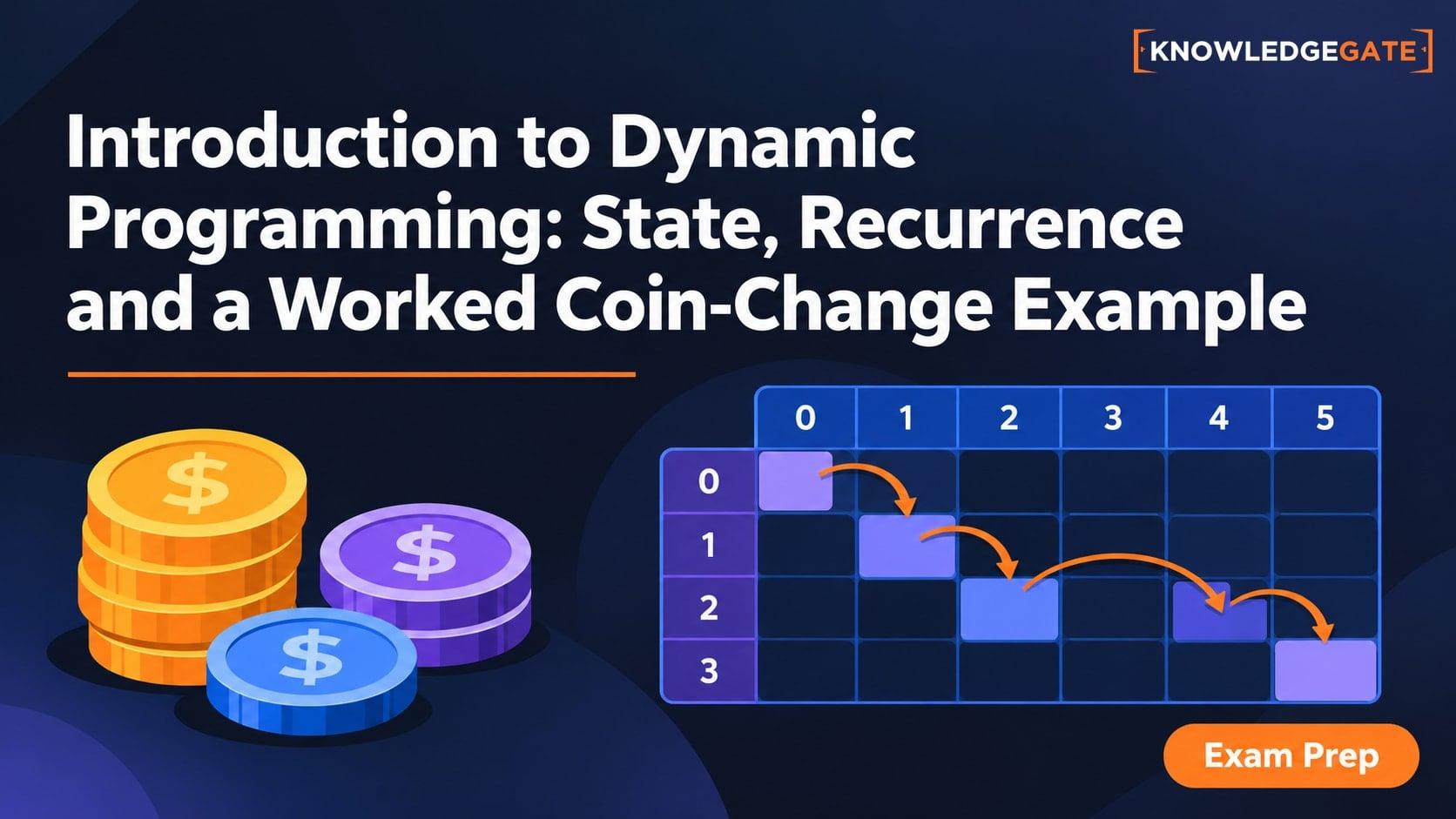
Introduction to Dynamic Programming: State, Recurrence and a Worked Coin-Change Example
Learn how to design a DP solution from zero, then apply the method to an unlimited coin-change problem using recursion, tabulation and answer reconstruction.
Updated 25 Nov 20266 min readDSA & Algorithms

Asymptotic Notations Explained: Big O, Omega and Theta with Worked Examples
Learn what upper, lower and tight bounds mean, prove a quadratic bound with constants, and trace a dependent nested loop without settling for a loose answer.
Updated 24 Nov 20266 min readDSA & Algorithms
Frequently Asked Questions
DSA Using Java is a structured, interview-focused programme built around data structures and algorithms, designed for product-based placement preparation. It is meant for learners who already have some programming background and want to focus specifically on DSA concepts and interview-style problem solving using Java.
Yes. Each of these language courses is described as covering programming concepts from basic to advanced level along with MCQ-style questions, so you get conceptual coverage alongside practice as you go through the material. Once you are comfortable with a language this way, you can move into DSA Using Java or Coding For Placements to apply that fluency to data structures, algorithms and placement-style coding questions.
KnowledgeGate's placement preparation spans the full drive: a TCS track for TCS's hiring exams, a Company Specific track for exams run by Infosys, Wipro, Accenture, Cognizant, Capgemini, LTI Mindtree, Deloitte and Hexaware, an IT Recruitment Exams track for AMCAT, CoCubes, eLitmus and CDAC C-CAT, plus standalone Aptitude and Resume & Interview courses. You can pick the track that matches the stage or exam you are preparing for.
This category includes dedicated courses in C, C++, Java and Python, each covering concepts from basic to advanced level. Alongside these, there are placement-focused programmes — DSA Using Java and Coding For Placements — which build on language fundamentals and apply them to data structures, algorithms and the kind of coding and MCQ questions asked in placement drives and technical interviews.
The C Language or Python course is a good starting point, as both cover programming from basic to advanced concepts. C gives you a grounding in how programming works at a lower level, while Python is often considered easier to pick up first — either works as a foundation before moving into DSA Using Java or Coding For Placements.
Computer Science Fundamentals for Placements bundles the six core subjects recruiters ask about most, including DBMS, Operating Systems and Computer Networks, into one course, so you can prepare for interview questions across these areas together. The course is taught by Sanchit Sir and works well both as a first structured pass through these subjects and as focused revision closer to placement season.
If you are not sure which company's drive you will appear for, start with the Aptitude track, since quantitative aptitude, logical reasoning and verbal ability are tested across most placement and recruitment exams. Once you know which company or exam you are targeting, move to the matching Company Specific, TCS or IT Recruitment Exams course for exam-specific practice.
You can start working on your resume and interview skills at any point, but most students take this course once they are close to or past the written round of a drive, when interview and HR rounds are the immediate next step.
Both, depending on which exam you pick. Semester/College, built around ZERO TO HERO, is oriented toward university semester exam preparation, while Placement, built around Sanchit Sir's Computer Science Fundamentals for Placements, is oriented toward campus placement interview preparation. ZERO TO HERO takes learners from foundational to advanced-level topics, while the placement course bundles the subjects recruiters ask about most into one place.
The course is built around core computer science subjects generally rather than one specific university's syllabus, so it works as a general foundational-to-advanced route through CS concepts that overlap with most semester exam patterns. Since it is not mapped to any single university's exact syllabus, it is worth cross-checking the topics covered against your own semester schedule before relying on it as your sole study resource.